
The Red Iris Key
An Agnes Blythe-Harrow investigation.


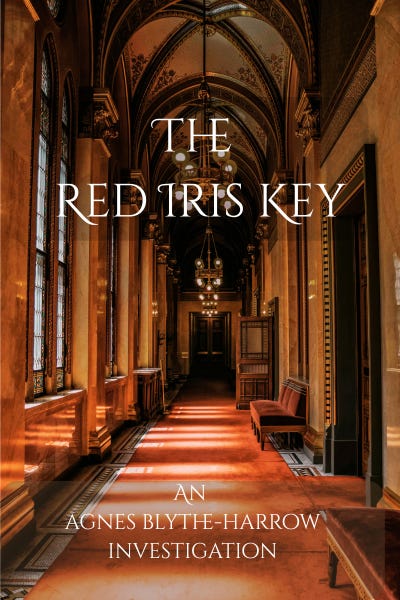
I moved through Parliament at a pace that suggested purpose rather than urgency, cane striking the stone in a rhythm that discouraged interruption. The buildings had been extended, renovated, stitched together over decades by people who believed power should be difficult to follow. Corridors doubled back on themselves. Stairwells appeared where no stairwell ought to be. Doors opened onto offices that felt provisional, as though they might quietly become something else if left unattended.
I knew the routes that mattered. The rest were camouflage.
The cane was unnecessary. I had taken it up years ago and found it useful. People made assumptions when a woman of my age carried a stick — softened their voices, hurried to hold doors, offered assistance I did not require. It shaved minutes off my day. Occasionally more. Playing the part others wrote for you did not require surrendering the script.
I had just come from the Prime Minister’s office. That alone explained my mood.
A junior adviser flattened himself against the wall to let me pass. Someone called my name — not loudly enough to be certain it was meant for me. I did not slow. There were days when Parliament felt less like a seat of government and more like a warren: whispers travelling faster than footsteps, information burrowing where it pleased, everyone convinced they knew where the centre was while remaining careful never to look directly at it.
I turned a corner that had not existed the last time I’d needed it and adjusted my grip on the cane. I did not like being tested. I liked it even less when the terms were absurd. Still, absurdity had rules, and rules could be exploited.
I had a speechwriter to find.
The closer I got to the offices I was looking for, the more the building began to stratify. Doors changed first. Heavy wood gave way to glass. Glass to swipe-card access. Swipe-card to the kind of polite obstruction that came with a smile and a lanyard. The language shifted with it — less deference, more procedure. People here spoke in terms of clearance and scheduling, of who had signed off and who would need to. Everyone knew precisely where they were allowed to stand.
It was all very familiar.
The Bureau had been much the same. Different architecture, certainly, but the logic identical: access disguised as order, power disguised as process. Corridors that promised nothing. Doors that opened only for those who already belonged. I had navigated those spaces without a key for most of my life. I had learned the routes that weren’t marked, the pauses where people filled silence with far more than they intended, the moment when certainty wavered and something useful slipped through.
I preferred that way of working.
The letter was still in my pocket. Red paper. Needlessly theatrical. I could feel it there, a thin irritation pressing against my hip as I walked. I had read it once, then again, and then a third time purely out of spite. Instructions, couched in concern. Precision masquerading as trust. And the key — absurd, arbitrary, unavoidable.
I had never needed a key before.
That, more than anything else, was what rankled. Not the task itself, but the implication. Keys were for people who believed doors mattered. I had always found it more efficient to go around them. Or through the person guarding them. Or to wait, patiently, until someone opened them without realising why.
Still. Agent Red had been annoyingly specific. And specificity, however insulting, was a form of information.
I slowed as I approached the corridor I wanted, letting my pace soften just enough to invite interruption. Somewhere nearby, a voice was already warming to the sound of itself — explanatory, eager, pleased with its own fluency. I adjusted my grip on the cane and turned towards it.
If I was to need a key after all, I might as well acquire it efficiently.
I found him exactly where I expected: hovering just outside the offices he was not technically senior enough to occupy, clutching a tablet like a shield and wearing the strained expression of someone who had been told his work mattered and then shown, in detail, that it did not.
“Ah,” I said, slowing just enough to let him see me. “There you are.”
He startled — always a promising sign — and recovered quickly, straightening as though posture might compensate for content. “Professor. I was just—”
“Trying to work out how a speech that was meant to reassure the country managed instead to sound like a departmental memo written by a frightened man with a thesaurus,” I said. “Yes. I gathered.”
He blinked. Once. Twice. Opened his mouth. Closed it again.
I did not give him time to regroup.
“It wandered,” I continued, tapping the cane lightly against the floor for emphasis. “It hedged. It explained itself to death. And at no point did it appear to notice that people are not, in fact, stupid. Was that intentional, or an unfortunate by-product of committee?”
“That’s not— I mean— if you look at it in context—”
I turned and began walking. He fell into step beside me without thinking, which told me everything I needed to know.
He talked as we moved. Of course he did. Speechwriters always did, once prompted — compelled by a deep and abiding belief that if they could only explain their choices clearly enough, those choices might retroactively improve. He gestured with his free hand, words spilling out in neat, eager constructions. He corrected himself mid-sentence. He reached for metaphors the way others reached for lifelines.
I listened just long enough to confirm the pattern.
There it was: the compulsion to qualify, to layer, to justify. The fondness for analogy. The inability to let a silence sit without rushing to fill it with something clever. His language ran ahead of his judgement, leaving small, useful gaps in its wake.
Perfect.
I adjusted my pace again — slower now, inviting elaboration — and angled my next question just slightly off-centre. Not enough to alarm him. Just enough to encourage a digression.
He brightened immediately.
As he spoke, I felt the letter in my pocket again, red and irritating, its instructions lining themselves up with the rhythm of his voice. I did not enjoy the alignment. I rarely enjoyed being proven right by people I did not respect. Still, efficiency was efficiency.
I let him keep talking.
I stopped walking.
That, more than anything, did it. He nearly collided with me, pulled up short, and laughed a little too brightly.
“Sorry—sorry. I just think people underestimate how much framing matters,” he said, relieved to have an audience again. “I mean, if you want the public to follow you, you have to give them a structure they recognise.”
I inclined my head. Not encouragement. Permission.
He seized it.
“Language inks intent onto policy,” he went on, warming to the theme now. “That’s where most governments go wrong. They think outcomes speak for themselves, but rhetoric is what actually carries meaning.”
I said nothing.
He filled the silence eagerly.
“And once you start explaining, you have to be careful not to rig the message against yourself. Over-qualification makes people suspicious. It’s like—” He searched for it, eyes lighting up as he found the comparison. “It’s like a lyre that’s been tuned too carefully. You lose the resonance.”
He gestured with his hand, pleased.
“A single wrong note,” he added, “a pause in the wrong place, a poorly chosen phrase—”
He stopped, frowned, and tried again.
“—and suddenly it doesn’t fly.”
He trailed off, the last word hanging oddly in the air between us.
Something shifted.
It wasn’t dramatic — no flash, no sound — just a faint sense of rearrangement, like a room subtly correcting itself. The speechwriter’s expression went slack, his focus drifting past me to a point somewhere over my shoulder. His hand, still half-raised from its last illustrative gesture, stilled completely.
I glanced down.
A small object rested on the floor between us, where there had been nothing a moment before. Cherry red. Shaped like an iris in bloom, its ridged petals curling inward to a narrow stem. It looked faintly obscene, as most things designed by committee eventually do.
I sighed.
The speechwriter didn’t notice. He was very still now, eyes unfocused, mouth slightly open as if he had been interrupted mid-thought and forgotten what the thought was meant to be. Not unconscious. Not asleep. Just… absent. Like a man waiting patiently for a prompt that would never come.
I nudged the key lightly with the tip of my shoe. Solid. Real.
“Honestly,” I muttered.
I bent, retrieved it, and slipped it into my pocket beside the letter. The red against red felt deliberate in a way I resented. When I straightened, the speechwriter blinked once, twice, and shook his head.
“Sorry,” he said, flushing faintly. “I was saying—”
“I know,” I said, already turning away. “Do try to remember next time that silence is not an enemy.”
He nodded, grateful, chastened, and entirely unaware that anything of consequence had just occurred.
I resumed my pace, cane tapping out its familiar rhythm as Parliament swallowed me again — corridors, doors, access points sliding past in their orderly confusion.
If Red is right, this is how I move forward. And if Red is wrong… well, we’ll find out soon enough.
And I will know who wasted my time.
I closed the door of my office behind me and set the key on the desk. It caught the light unpleasantly, red against the dark wood, too bright to be ignored.
Easing myself into my chair, I sat for a moment, regarding it, while I considered my options.
Corroboration was something I had never relied upon, and generally preferred to work alone. Still, it would be irresponsible not to confirm whether I was the only one being tested. If keys were in circulation, I needed to know who else had one.
I had worked with many agents in the Bureau. I had worked with monsters, men, and things that insisted they were neither. The distinction had never been especially useful. I trusted very few of them. None of those had been human.
Only then did I look up.
The mirror on the far wall had been there longer than I had. Ornate frame. Foxed glass. The sort of object people assumed was decorative because they preferred that explanation. I had never made that mistake.
Leo was already there.
Not reflected — present, occupying the wrong depth, his outline resolving slowly as though the mirror were deciding how much of him to allow through. Eyes sharp. Tail flicking thoughtfully. Waiting.
Written in response to Kelly Xan’s Bureau of Barbarity world-building writing prompt: “An Agency of Atrocity.” Leo belongs to Qibra’s Bureau canon, and this piece marks the beginning of a crossover between our respective hunters. More to come.
Want to read more Agnes stories?
Go back to where it all began with The Parliament of Small Talk.
Tradition Waits for No One sees Agnes navigating Christmas events in Wellington.
Wide Glasses is a New Years’ Eve story where she shares a moment with the shade of an infamous former NZ PM.
 | A guest post by
|
i like this... felt like a darker, smarter, deeper Charles Stross "atrocity archives" piece. keep it up 💥💥💥
My gosh, this was like a Christmas pudding! Is there a part two?