

I have never trusted vessels that promised elegance without risk.
Therefore, I hold the firm opinion that champagne flutes are a lie.
A narrow, upright lie, designed for standing, not for living.
“You can’t smell anything out of those,” I once said, holding one at arm’s length like it might confess if shaken hard enough. “What’s the point of wine you’re not allowed to know properly?”
I prefer the old glasses. The wide ones. The kind that wobble if you gesture too hard.
“They demand respect,” I declared. “You have to slow down. Pay attention. Accept that you might spill. That’s honesty.”
The ghosts were unusually visible that night.
Not fully — not in any cinematic sense. No chains, no translucence. Just present. Corporeal enough to cast a suggestion of weight, to interrupt sightlines, to displace air. I noticed them weaving at the edges of the reception, threading between living bodies with the faint impatience of people long accustomed to being deferred to.
They aren’t usually like this. Most of the year they keep to drafts and corners, to the upper levels of stairwells and the uneasy silence before a vote. Parliament blurs them for its own comfort. New Year’s loosens things.
I catalogue them without fuss. I always do.
Seddon presses down on doorframes and corridors — a lingering density problem. You feel him most in February, when tempers run hot and the building seems to breathe too shallowly.
Lange interferes with sound. Microphones feed back. Arguments loop. People laugh a fraction too late, as if trying to catch up with themselves.
They’re manageable. Predictable. Part of the infrastructure, like the wiring or the leaks everyone pretends not to see.
Then I heard the laugh.
It wasn’t loud. That was the problem. It didn’t announce itself so much as assert itself, threading through the room with a confidence that assumed it would be recognised. If pressed, I would struggle to describe it — a bark without humour, perhaps, or a chuckle stripped of warmth and sharpened by satisfaction. It carried the sense of a man amused by his own interruption.
I felt it before I placed it.
Across the room, Mortimer stiffened.
He turned his head too quickly, scanning faces with naked alarm, champagne sloshing dangerously close to the rim of his glass. I followed his gaze and found him at the edge of the crowd, half-hidden behind a column, unmistakable even now.
Muldoon does not haunt quietly.
He ruled in the seventies and early eighties, when power was loud and unapologetically masculine, and a man could govern by sheer force of personality if he talked long enough and refused to yield. He believed in control — of the economy, of the room, of the argument — and mistook domination for clarity. People used to say you always knew where you stood with Muldoon. What they meant was that he made very sure you stood somewhere beneath him.
He lingers where conversations narrow, where people are mid-sentence and suddenly unsure whether to continue. He leans, figuratively speaking, into proximity. I once decided that if Muldoon has a supernatural signature, it isn’t cold or darkness but compression — the sense of space being reduced until only one voice can comfortably occupy it.
Mortimer swallowed. I remembered, dimly, the shade of Muldoon cornering him one year near the debating chamber. I’d found Mortimer afterwards in the corridor, pale and shaking, unable to articulate what had been said — only that he’d felt spoken at rather than to, flattened by certainty. He never quite recovered his timing.
I took a careful sip from my wide, wobbling glass.
The ghosts, I thought, were one thing.
But some of them still believed the room belonged to them.
And that, I suspected, was about to become a problem.
After the laugh, it took me a moment to find him.
The Backbencher was busy enough that presences overlapped — living bodies, old arguments, caricatured versions of both. I tracked him by density: a slight narrowing of conversation, a dip in laughter, the way people’s shoulders turned without quite knowing why.
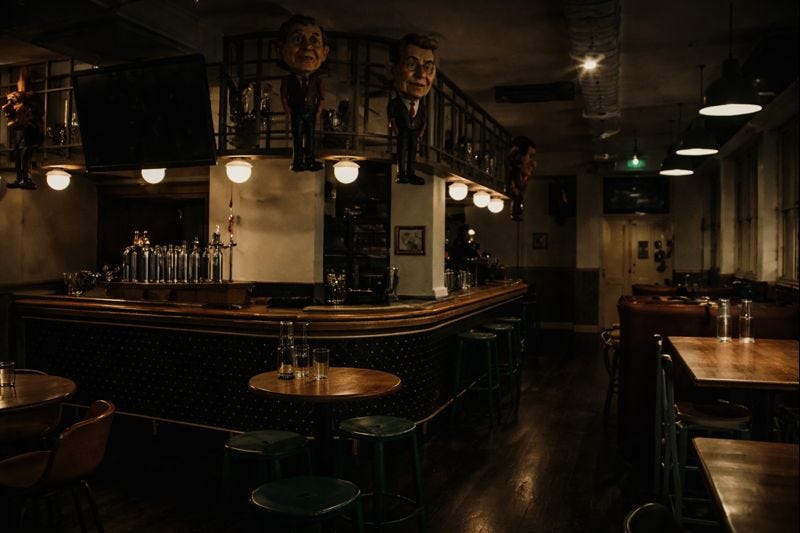
I found him standing beneath his own likeness.
The latex effigy was exaggerated in the way caricature always is — the mouth too wide, the expression frozen halfway between amusement and threat. It had aged badly, which seemed appropriate. Muldoon regarded it with something like approval.
“Still recognisable,” he said, without turning. “That’s the trick.”
I didn’t respond. The thing about monuments — even rubber ones — is that they invite commentary. Muldoon never waited for permission.
“They don’t make them like that anymore,” he went on. “Too nervous. Too worried about how things sound.”
He smiled then, a private, satisfied movement that never quite reached the eyes. The effigy smiled back, permanently.
“This place remembers,” he said. “That’s why it lasts.”
He drained a glass I hadn’t seen him collect and set it down with unnecessary precision. Then he turned toward the door, already assuming I would follow.
Outside, the noise dropped away all at once.
The air was cooler, carrying the harbour and the promise of weather. Across the road, the Beehive sat lit and quiet, its windows dark, as if waiting for something it no longer needed to host. Muldoon stood with his hands loosely clasped behind his back, looking at it the way men look at buildings they still feel entitled to.
“You keep things tidy now,” he said. “Lots of talk. Very little decision.”
I joined him at the railing, careful with my glass. It wobbled, as it should.
“We make decisions,” I said. “We just don’t pretend they’re virtues.”
That was when he laughed again — the same sound as before, sharp and proprietary — and for the first time, it didn’t seem to know where to go.
He didn’t look at me when he spoke.
“You lot talk yourselves into corners now,” Muldoon said, eyes fixed on the Beehive. “Endless process. No stomach for the hard call.”
I stood beside him, not quite shoulder to shoulder. Close enough to be present. Far enough not to cede ground.
“We talk because people expect to be heard,” I said. “It slows things down.”
He gave a small snort. “It weakens them.”
“That’s one way of seeing it.”
He turned then, finally, and assessed me with something like interest. Not approval — he never approved — but recognition. I had the uncomfortable sense that he was trying to place me in a taxonomy that no longer existed.
“You’d have done better in my time,” he said. “You understand order.”
I took a sip from my glass and considered his words.
“I understand restraint,” I said. “They’re not the same thing.”
His smile sharpened. “People want certainty.”
“People want to stop being shouted at,” I rejoined. “Certainty is just what shouting sounds like when it’s won.”
That earned me the laugh again — closer this time, directed at me. He enjoyed resistance. Always had.
“You mistake civility for strength,” his voice took on a harsh tone. “When things get hard, they still want someone to take charge.”
This was his favourite move — to confuse fear with preference, and call it truth.
“They want someone to listen, you never did.”
The air tightened. I felt it — that familiar pressure, the old reflex to narrow, to dominate by proximity alone. He stepped closer. I didn’t move.
“I kept the country together,” the line was delivered like a credential, not a claim — something he believed should still carry weight.
Honestly, the injured authority with this man was breathtaking.
“You kept talking until no one could interrupt you,” I replied. “That’s not the same thing.”
For a moment, he looked genuinely puzzled. As if the distinction had never been offered to him in good faith.
“You always knew where you stood with me,” his voice louder now. He needed volume. He always did.
“Yes,” I agreed. “Usually underneath.”
That did it.
The laugh came again, barked out of habit rather than pleasure, and this time it rang oddly thin against the quiet street. No one inside the Backbencher shifted. No conversation rearranged itself to accommodate the sound.
He glanced back toward the door, just once.
“They’ll learn,” he muttered. “They always do.”
“Only if we let them,” I didn’t raise my voice.
He held my gaze for a second longer, as if deciding whether I was worth the effort. Then the pressure eased. The space widened. When I looked again, he was no longer there — not vanished, exactly. Just absent, like a voice that had finally realised it wasn’t being answered.
I stood for a moment longer, watching the Beehive glow at nothing in particular.
Then I went back inside, where the noise rose to meet me and the room felt, unmistakably, wider.
Uncomfortably familiar.