
Pet Management
When you shrink the residents but not the world, pet ownership becomes complicated.

Flash Fiction February, Day 17. The brief: Forced Perspective — a near-future shrinking experiment, a prototype neighbourhood, and the uncomfortable discovery that others have already adapted. Each day’s 1.5K cap keeps the stories tight — even when the world isn’t.
The welcome packet was laminated — my first clue this wasn’t reversible.
It lay in the middle of the cul-de-sac like a tiny, glossy dare, edges perfectly sealed against moisture, as if whoever designed Phase One had anticipated tears, weather, or blood.
Welcome to Sustainable Micro-Living™ – Community Guidelines.
The street around it had once been immaculate. You could see the intention in the symmetry — identical pastel houses, identical hedges trimmed into polite cubes, identical white mailboxes standing at attention.
But that intention had already been tampered with and the symmetry of the place had already begun to lose the argument.
The recycling bins towering at the end of the street had clearly become a quarry, cardboard and plastic from the full-sized world towering over the development like abandoned architecture. A cereal-box extension leaned awkwardly off one roof. A yoghurt lid had been repurposed into a balcony. Someone had strung dental floss between two houses in what might have been a laundry line or a tripwire.
I was still deciding whether the place was deliberately adorable or accidentally insulting when the ground began to hum, the vibration travelling up through my shoes and into my ribs.
I knew that purr.
A great shadow fell, sliding over the neat hedges and the little plastic mailbox with my name printed in cheerful font.
I looked up.
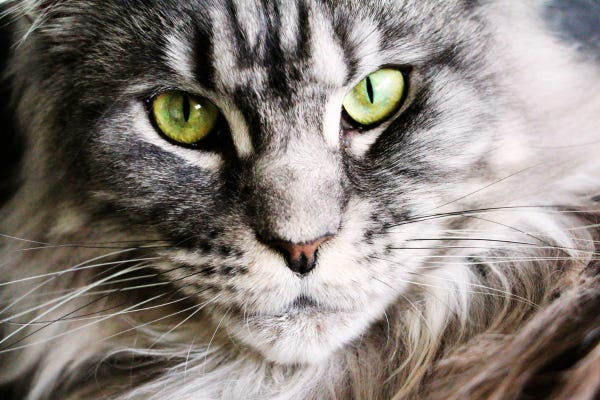
Two amber suns rose above the roofline of my new house.
The monster tilted his head.
He chirped — his hunting chirp I knew so well.
“Oh, you have got to be kidding me,” I muttered.
Pawlie The Fat Bastard had found me.
He was magnificent — silver and white, broad-chested, ear tufts like a lynx, tail unfurling behind him like a war banner. An expert hunter. No prey escaped unnamed. And with a cold, sinking clarity, I understood he was looking at me the same way he looked at anything that moved.
“Pawlie, no.”
His ears twitched. He registered the voice.
Then he stepped forward.
The paw came down hard enough to crack pavement.
Before I could think, a hand seized my collar and yanked me under cover, beneath the shadow of a two-storey extension constructed from a yoghurt lid and the side panel of a laundry powder box.
A dozen faces stared at me.
I recognised several of them — Bevan from three houses down, still wearing his running club visor; Marta from the corner dairy; old Mrs Parata, who used to complain about my recycling habits.
“This is your fucking cat?” Bevan demanded.
He shoved a laminated card at my chest — identical, perfectly sealed — a finger stabbing at the line:
Residents must manage their own pets.
Outside, Pawlie’s tail swept through the cul-de-sac like weather.
“He’s just… enthusiastic,” I said.
They did not look reassured.
“So, now that you’re all, you know… pocket-sized—” I began.
“Uh, actually,” Bevan cut in, adjusting his running visor, “we prefer ‘Scale-Adjusted.’”
“Of course you do.” I took a breath. “Now that you’re Scale-Adjusted, what are you keeping as pets?”
“Crickets,” someone muttered.
“Ants.”
“Ladybugs,” a woman added. “Pretty cute. Still nasty fuckers.”
“Neville’s got an earthworm he’s very proud of.”
They stepped aside.
Neville stood solemnly with an earthworm draped around his shoulders like a ceremonial sash. He fidgeted nervously with the edge of his cardigan at the sudden attention.
Bevan looked past me toward the street.
“So what’s the plan?” he asked tightly. “Because if your cat starts again, we can’t hold him off.”
“What are you thinking?” someone muttered. “Floss?”
A soda-tab blade flashed in nervous emphasis.
I glanced toward Pawlie, who was currently evaluating a yoghurt-lid balcony as though considering whether it qualified as prey.
“He’ll calm down,” I said, with more confidence than evidence.
They all looked at me.
“He better,” Bevan replied.
Outside, Pawlie gave the balcony a final experimental shove, then seemed to decide it wasn’t worth the effort. He circled once, tail high, and folded himself into what had been Felicia’s house — a cardboard jewellery box lined with dryer lint and optimism.
The box crumpled.
Felicia stared as if watching a lifetime mortgage evaporate.
Pawlie tucked his nose beneath his tail and closed his eyes.
For several long seconds, no one moved.
Then the cul-de-sac exhaled.
Weapons lowered first — toothpick spears tipped down, soda-tab blades tucked into belt loops made of elastic thread. Someone retrieved a floss line from where it had snapped loose. A woman righted a cereal-box extension with the gentle resignation of someone who has done this before.
Conversation resumed in low, cautious threads.
“We’ll have to reinforce the west side,” Bevan murmured.
“The wind comes through there now,” someone replied. “Ever since the vent cycle changed.”
Felicia looked morosely over at what was left of her jewellery-box home and began gathering dryer lint that Pawlie had turfed out, in careful, salvageable handfuls.
Adaptation here was constant. Nothing stayed where it had been left. Grass grew too fast. Ants became neighbours. Dew was a flooding event if you misjudged it.
Even the light felt different — harsher, refracted through blades of lawn that loomed like scaffolding.
I watched them move through it with the weary competence of people who had stopped expecting stability.
For a moment — a fragile, negotiated one — it felt almost manageable.
And then the scraping began.
A dragging, granular sound threading through the grass.
The residents reacted before I understood what they were reacting to. Spears lifted in unison, floss lines drawn taut between hands that had learned exactly how much tension they could trust. The soda-tab blades caught the light, thin and bright.
No one shouted.
They simply turned with bleak resignation toward the far end of the street.
The grass there shifted, not with wind but with weight, bending in a slow, deliberate ripple.
A blunt pink snout eased through first, whiskers twitching. Behind it came muscle — rope-thick and scarred — and a body that seemed to unfold as it advanced. The smell reached us before the rest of it did: sour fur, damp concrete, the stale insistence of something that survives by chewing through what resists it.
“Rats,” Bevan said.
The word moved through the group without drama.
When we were full-sized, a rat meant swearing and a broom.
Here, it meant rebuilding the street. Maybe even death.
The first one stepped fully into the cul-de-sac and paused, surveying us with the bored entitlement of something that had been here before.
Neville whimpered.
The earthworm did not re-emerge.
It took me a second too long to understand what they were waiting for.
The rat advanced another pace, claws ticking softly against pavement. Around me, the residents braced, lifting makeshift weapons that would never be enough.
From inside Felicia’s flattened house, Pawlie’s tail gave a slow, irritated twitch.
Of course he had heard it.
He was just waiting to be asked.
I stepped out from the shelter of the recycling wall, the movement drawing a sharp intake of breath behind me.
“Pawlie,” I said, keeping my voice level.
One silver ear turned toward me.
The rat lifted its nose.
“Pawlie. Rat.”
Sleep vanished as his pupils swallowed the gold of his eyes.
He rose, immense, and launched.
Pawlie hit the rat with the full weight of himself. Bone cracked against pavement; the scream ended mid-note. His jaws closed around its spine with a sound like snapping kindling, and when he shook, blood flecked the street in dark arcs.
When he dropped it, the body lay wrong on the pavement.
Silence spread through the cul-de-sac — thick, suspended — as the residents stared at Pawlie standing over his kill, whiskers painted red, ancient and entirely certain of himself.
Then the grass shifted again.
Not one ripple this time, but several — scarred backs and yellow teeth pressing forward, drawn by blood.
The residents tightened their formation, weapons lifting in a reflex they had clearly practiced.
Pawlie did not move.
He lowered his head slowly and closed his jaws around the first rat’s skull, never breaking eye contact with the newcomers.
The crack carried.
He chewed, making disturbingly loud squelching sounds.
The pack faltered. One step back, then another, until the grass swallowed them again and only flattened stems remained.
Pawlie gathered what was left of his kill and carried it back to Laetitia’s collapsed jewellery box, settling inside with a rustle of cardboard before beginning to eat — noisily, enthusiastically, with the wet, unapologetic focus of something that had just secured territory.
Laetitia made a faint, wounded sound.
Around me, the residents lowered their weapons.
No one mentioned zoning.
I retrieved the laminated packet where it had blown against the curb and wiped a streak of blood from its glossy edge.
Section 4.2: Residents must manage their own pets.
I held it up.
“Well,” I said.
From inside Laetitia’s former home came the steady, satisfied squelching of victory.
“I managed it.”
The cat....is savage. We see their life with new eyes & rats creep me out. Creep me out!!! So this was chilling & fierce.
“we prefer ‘Scale-Adjusted.’' 😆...I believe they have bigger problems to worry about. This story made me realize how truly terrifying cats would be if they were bigger than us. Excellent work Wendy especially the world building. We see the world they built. Loved the ending!