

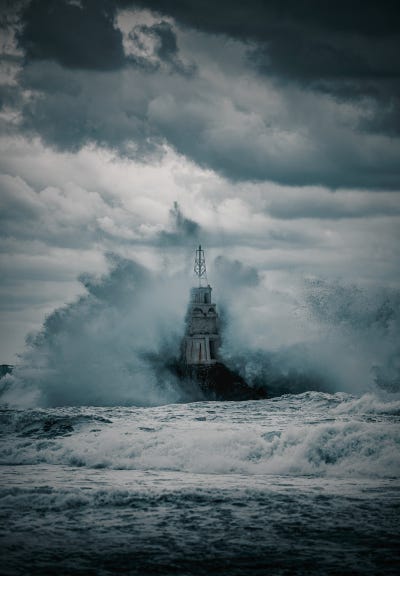
Simon took the stone stairs two at a time.
Not running — he refused to give it that name — but moving fast enough that his breath rasped and his foot slipped once on a familiar edge. The lighthouse groaned at the suddenness of it, the spiral sinking back into the floor behind him, stone swallowing stone until there was nothing left but solid ground — and the echo of what he’d fled.
He reached up without looking and hung the key on its hook at the top of the stairs. The motion was automatic. Necessary. He didn’t pause to check it was seated properly — he never did — only turned away as if distance alone might count as restraint.
The keeper’s room was one space, really. Everything bled into everything else.
The narrow bed. The table. The little iron sink bolted into the wall beneath the window.
Simon leaned into it, palms braced, head bowed. His pulse was loud in his ears. He twisted the tap and let the water run, cold and relentless, splashing his wrists, his face. He scrubbed his hands as if he could erase the feel of stone and shadow and the heat that still clung to him like a second skin.
Flustered. Exhilarated. Ashamed enough that it barely registered.
He dragged a sleeve across his mouth and sucked in a breath that wouldn’t quite steady.
Behind him, from deep beneath the floor — rising up the stone throat of the tower —
“What was that, Simon?”
Amused. Mild. Absolutely not asleep.
Simon froze.
“You’re awake,” he said, because it was easier than anything else he might have said.
A pause. Then a laugh — low, pleased, intimate enough to make his teeth ache.
“Did you expect me to sleep,” Cassian asked mildly, “After you stood there pretending you weren’t thinking about my hands?”
Simon closed his eyes.
“You’re not meant to speak,” he said.
“And you’re not meant to come downstairs alone,” Cassian replied. “Yet here we are. Still finding new ways to disappoint each other.”
Simon rested his palm against the stone, feeling for the colder patch — the boundary he pretended still mattered.
“Tell me,” Cassian went on, as if they were resuming a conversation paused rather than a war postponed, “do you still call this guarding… or have you finally admitted it’s just fear with better branding?”
Simon fidgeted with the edge of his cardigan. Cassian always noticed that — the way Simon’s hands betrayed him before the rest of him caught up.
“You always liked calling it fear,” Cassian said. “Makes it sound small. Sensible. Something a man can live with.”
Outside, the wind rose hard enough to make the iron railings hum beneath Simon’s grip.
“It’s not fear,” Simon muttered. “It’s containment.”
A soft sound drifted up from below. Not laughter this time.
Satisfaction.
“Oh, Simon,” Cassian murmured. “You were never very good at lying to me.”
“You’re contained,” Simon kept his voice steady by force of habit. “That’s the point.”
“And you’re not.”
Cassian didn’t rush it.
“That’s the problem.”
The words slid into him, sharp as remembered hands.
Simon flexed his fingers, grounding himself in iron railings, cold stone, the slow, familiar ache of a body that never tired and never healed properly either. Cassian’s idea of eternity. You’ll thank me later, he’d said. You won’t have to lose me.
Simon dragged in a breath and held it too long, as if containment was something he could practice.
“You did this to yourself,” he said into the space between heartbeats. “Whatever you think you’re owed—”
“I’m owed nothing,” Cassian cut in smoothly. “I’m offering you something.”
Quiet again.
Then, quieter:
“A choice.”
Simon laughed despite himself. It scraped out of him, rough with disuse. “You took that from me centuries ago.”
“I borrowed it,” Cassian rejoined. “You gave it willingly. You always did. That was the part I loved.”
There it was. Not the threat. Not the seduction.
The truth.
“You could leave,” Cassian continued lightly, though his meaning was heavy as the stone that held them. “Walk straight out of that door. Let the light die. Let the sea take this place apart stone by stone. You know it would come for me eventually.”
A wave struck the island hard enough to shudder through the floor, salt spray rattling the panes like thrown gravel.
Simon turned then. Not toward the door. Toward the centre of the room, where the spiral descended into darkness.
“And if I don’t?” he asked, the words echoed off the cold stone.
Cassian’s voice softened. Dangerous.
“Then we stay like this,” he said, his voice taking on a sing-song quality. “You guarding. Me waiting. You pretending this isn’t still about us.”
A breath. Almost a sigh.
“I’m very patient, Simon.”
The lighthouse groaned as the wind rose — a sound like an old animal shifting in its sleep.
Simon rested his palm against the stone above the prison. It was colder than the air, damp with centuries of breath and tide, leaching heat from his skin.
Cassian didn’t speak for a while.
That, more than anything, made Simon uneasy.
The hush pressed in — thick, intimate. The kind that used to come right before Cassian closed the distance between them, pupils blown, before the world narrowed to breath and skin and the inevitability of being touched.
Simon swallowed.
He became suddenly, painfully aware of himself.
The soft give of his body beneath wool and cotton. The cardigan he’d buttoned out of habit rather than warmth. The corduroy slacks worn thin at the knees, the ridiculous slippers he’d found abandoned in the keeper’s quarters decades ago and never replaced. Practical. Sensible. Small.
He hadn’t been small once.
Once, Cassian’s hands had fit him like intention.
The memory hit him low and sharp — Cassian bare-chested, all lean muscle and coiled strength, shoulders rolling as he moved, a body made to be seen and known. Simon reaching for him first, fingers curling into skin, claiming what he’d already decided was his. Cassian towering over him, heat and confidence and wicked delight, thighs hard as stone even then, laughter bright and dangerous in the dark. Lips and teeth against his throat…
Simon tightened his fingers on the railing.
For a flicker — traitorous, humiliating — he was almost grateful for the door between them. Grateful that Cassian couldn’t see what time had done to him. What eternity had softened.
The thought barely formed before—
A low chuckle rolled up from beneath the stone.
Filthy. Knowing.
“Oh,” Cassian murmured, “There you are.”
Simon’s breath hitched. “Don’t.”
“Don’t what?” Cassian asked lightly. “Notice you?”
Another pause. Deliberate.
“Miss you?”
Heat crept up Simon’s neck. “You don’t get to—”
“I get to do exactly what I’ve always done,” Cassian cut in, voice velvet-dark. “Tell the truth you’re too polite to name.”
The stone beneath Simon’s palm felt warmer. Or maybe that was him.
“You’re thinking about the way I used to look at you,” Cassian went on, almost lazily. “Like you were something I’d chosen. Like you were mine.”
Simon stared at the stone beneath his hand as if it would hold him steady.
“You’re thinking about my hands,” Cassian said softly. “How they felt on you. And how little they cared about clothes. Or age. Or whatever dull story you’ve decided to tell yourself about worth.”
“Stop,” Simon breathed, but there was no heat in it. No edge.
Cassian laughed again — quieter now. Closer.
“As if any of that ever mattered,” he purred. “You think I loved you because you were young? Because you were hard? Because you matched me?”
Simon’s careful balance wavered.
“I loved you because you stayed,” Cassian said. “Because you chose me. Again and again. In rooms much darker than this.”
Simon’s chest ached. His body betrayed him with a flicker — unwanted, undeniable — and he hated himself for it even as it warmed him through.
Beneath the stone, the pause lengthened — intimate, appraising.
A breath. Almost tender.
“If I were standing in front of you now,” Cassian said, unhurried, “you’d remember exactly why you never needed to feel worthy.”
The lighthouse groaned as the wind shifted.
Simon didn’t move.
But for the first time in a very long while, he couldn’t quite tell whether the ache in his chest was resolve—
—or longing.
Simon hadn’t realised he was crying until the wetness reached his mouth.
Not the ache, not the wanting. The softness of it. The way his body betrayed him with salt and breath and a small, broken sound he couldn’t swallow back fast enough.
Cassian felt it immediately.
The change was instant.
“Oh,” he said — and the word was no longer sharp.
It softened, rounded at the edges.
“There you are.”
Simon wiped at his face with the back of his hand, angry now. At himself. At the years. At the way Cassian could still reach inside him and press exactly where it hurt.
“I didn’t mean—” Simon began, then stopped. The sentence had nowhere to go.
Cassian’s voice dropped, not in seduction now, but in something quieter. Close. The voice of someone who once knew how Simon took his tea. How he slept. How he needed to be touched after.
“Easy,” Cassian murmured. “You don’t have to be anything right now.”
Simon’s breath shuddered.
“I know what it’s like,” Cassian went on tenderly. “To wake up one day and realise the world has moved on without consulting you. To feel… left behind in your own body.”
Simon hated how much that landed.
“You’ve done so well,” Cassian’s soft register continued. “Holding this place together. Holding yourself together. You were always good at that.”
The lighthouse creaked. The sound wrapped around them like a held breath.
Simon’s gaze drifted — without quite meaning to — to the hook by the stairwell.
The key hung there.
Dull brass. Worn smooth by centuries of his touch.
Cassian followed the stillness like a pulse, homing in on Simon’s hesitation the way he always had — instinctively, hungrily.
“You don’t have to open it. Not for me. Not tonight.”
Simon’s fingers curled.
“But you could,” Cassian added, voice all smoke and honey. “Just to sit with me. Just to remember what it feels like not to be alone.”
Simon took a step forward before he could stop himself.
The key swung slightly on its hook. The wind fell away so suddenly the silence rang — as if even the sea were waiting to see what he would do.
Gods help him, he let himself imagine it — the door opening, the stone parting. Cassian rising, all heat and solidity and impossible familiarity. His hands steady, certain. The relief of being held without having to explain himself.
Then —
Something clicked.
Not the lock.
The tone.
The way Cassian had stopped saying I and started saying you.
The way the care had arrived precisely when the tears did.
The way the offer had been framed as mercy.
Simon forced himself to stop.
He didn’t look at the key this time.
He rested his hand flat against the stone — not above the prison, not in benediction, but like a boundary.
“No,” he said quietly.
Cassian stilled.
Not dramatically. Not defensively.
Just — attentive.
“No,” Simon repeated, firmer now. “You don’t get to do that.”
A pause.
“To what?” Cassian asked, lightly enough that it might have fooled someone else.
“That. You don’t get to decide what I need and call it kindness.”
No answer.
Not listening.
Waiting.
Simon drew a breath, surprised to find it didn’t hurt as much this time.
“I’m still here,” he said. “And you’re still contained.”
The words didn’t shake.
For once, Cassian didn’t answer right away.
The quiet stretched — not intimate now, not coiled. Empty. Exposed.
When Cassian finally spoke, the voice was lower. Stripped of its music.
“For now,” he said.
Simon didn’t respond.
Below the stone, nothing moved.
No breath. No laugh. No recalibration.
Only silence — heavy, resentful, and for the first time in centuries,
Unoffered.
Your musical pairing for this one:
Written in response to Bradley Ramsey’s Power Up Prompt #25 01.10.26. I didn’t expect it to go where it did.